Showing posts with label 9th Work Power and Energy. Show all posts

27 September 2023

CBSE Work, Energy and Power class 9 Physics assignment

CBSE IX PHYSICS:

1. Under what conditions work is said to be done?

2. State the energy changes taking place in the following cases: (i) A car moves up a hilly road.(ii) a stone projected vertically upward returns

3. Give few examples where energy is possessed by a body due to its change in shape.

4. When we cut a log of wood with a saw it becomes warm, why?

5. Is it possible that force is acting on a body but still work done is zero? Explain.

6.  A rocket of mass 3x10⁶ kg takes off from a launching pad and acquires a vertical velocity of 1 km/s  at an altitude of 25 km. calculate (a) the potential energy and (b) the kinetic energy. (g = 9. 8m/s2)

7.  If a man lifts a load up with the help of a rope such that it raises the load of mass 50 kg  to a height of 20 m in 100 sec. Find the power of man

8.  A ball is dropped from a height of 5m. Find the velocity of the ball just before it reaches the ground.  Do you require the value of mass to find the velocity?

9.  Two persons A and B do same amount of work. The person A does that work in t1 sec  and the 
person b in tsec. Find the ratio of power delivered by them.

10.  Why do our hands become warm when rubbed against each other? Explain.

11. The kinetic energy of a body of mass 15 kg is 30J. What is its momentum?

12.  Give an example for each of the following energy conversion: (1) electrical energy to kinetic 
energy. (2) Chemical energy to electrical energy (3) sound energy to electrical energy

13.  Two bodies have same momentum. Which will have greater kinetic energy- heavier body or lighter
body?

14.  An electric bulb of 60w is used for 6h per day .Calculate the units of energy consumed in one day 
by the bulb.

15. A boy of mass 50kg runs up to a stair case of 45 steps in 9s. If the height of  a  step is 15cm, find 
his power. (g= 10m/s2)
16.  Two particles of masses 1g and 2g have equal momentum. Find the ratio between their kinetic energies?

17.  What will be the work done by the string, when a stone is tied to a string and whirled in a circle?

18.  A locomotive exerts a force of 7500N and pulls a train through 1.5 km. How much work is done 
by locomotive?

19.  What work a boy of mass 50kg will do in order to increase running speed from  9km/h to 18km/h.

20. The speed of a moving body is halved. What is the change in its K.E.?

Solved CBSE Test papers:

Class 9 Work, Energy ,Power_ Solved Questions - 01

Class 9 Work, Energy ,Power_ Solved Questions - 02

Class 9 Work, Energy ,Power_ Solved Questions - 03

Class 9 Work, Energy ,Power_ Solved Questions - 04

Class 9 Work, Energy ,Power_ Solved Questions - 05

Class 9 Work, Energy ,Power_ Solved Questions - 06          

21 November 2015

Numerical on work and energy for class 9 [with solution]

  Class 9 Chapter Work and energy Solved Numerical problems

1. A force of 10N causes a displacement or 2m in a body in its own direction. Calculate the work done by force. 20j

Solution: the work done by force = F x S = 10 N x 2m = 20 J

2. How much force is applied on the body when 150 joule of work is done in displacing the body through a distance of 10m in the direction of force?(15 N)

Solution: W = F x S Þ  F = w/s = 150/10 = 15 N

3. A body of 5kg raised to 2m find the work done(98j)

Solution: T he work done to raise a body = PE = mgh = 5kg x 9.8 x 2 = 98 joule

4. A work of 4900j is done on road of mass 50 kg to lift it to a certain height. Calculate the height through which the load is lifted. (10m)

Solution: work done on road to lift = mgh Þ 4900 = 50 x 9.8 h Þ h = 10m

5. An engine work 54,000J work by exerting a force of 6000N on it. What is the displacement of the force . (9m)

Solution: S = W/F = 54,000J/6000N = 9m

6. A force of 10N acting on a body at an angle of 60 deg. with the horizontal direction displaces the body through a distance of 2m along the surface of a floor. Calculate the work done.

Now let the force or pulling act on the body makes an angle of 30 deg. with the horizontal. What is the value of the force to displace the body through 2m along the surface of the floor? (Cos 60 =1/2. and Cos 30 = √3/2) [ ans. 10 J, 10√3 N]

Solution: w = F S cos Q = 10 x 2 x Cos 60 = 20 x ½ = 10 N

w = F S cos Q = 10 x 2 x Cos 30 = 20 x √3/2 = 10√3 N

7. A force of 5N acting on body at angle of 30 deg. with the horizontal direction displace it horizontally through of distance of 6 m . Calculate the work done. (15√3 J)

Solution: w = F S cos Q = 5 x 6 x √3/2 = 15√3 J

8. A body of mass 2kg is moving with a speed of 20m/s Find the kinetic energy. (400J)

Solution: KE = 0.5 mv^2 = 0.5 x 2 x 20 x 20 = 400 J

9. A moving body of 30kg has 60 J of KE. Calculate the speed.

Solution: KE = 0.5 mv^2  Þ 60 = 0.5 x 30 x v^2
Þ 60 = 15 v^2 Þ 60/15Þ V = 2m/s

10. A hammer of mass 1kg falls freely from a height of 2 m .Calculate (I) The velocity and (II) The KE. of the hammer just before it touches the ground. Does the velocity of hammer depend on the mass of hammer? (6.29m-2 , 19.6 J )

Solution: PE = mgh = 1 x 9.8 x 2 = 19.6 j

PE = KE = 0.5 mv^2 Þ 19.6 = 0.5 x 1 xv^2 Þ 39.6 = v^2 Þ v = 6.29 m/s

No, velocity of hammer does not depend on the mass of the mass of the hammer as v = u + at

11. Calculate the energy posses by a stone of mass 10kg kept at a height of 5m If 196 x10^2 J of energy were used to raise a 40kg boy above the ground, how high would he be raised? (50m)

Solution: The energy posses by a stone of mass 10kg kept at a height of 5m = PE

PE = mgh = 10 x 5 x 9.8 = 490 j

PE = mgh  => 196 x10^2 J = 40 x 9.8 x h => h =  50m

12. Calculate the change that should be affected in the velocity of a body to maintain the same KE , if mass of the body is increased to 4 times (half the original velocity)

Solution: New kE/Original KE = [½ x 4m x V^2]/[ ½ x m x v^2]

¼ = (V/v)^2   Þ   ½ = (V/v) Þ V = v/2

New velocity will be half the original velocity

13. A machine does 192 J of work in 24 Sec. What is the power of the machine? (8w)

Solution: p = w/t = 192 J / 24Sec = 8w

14. A weighting 50kg runs up a hill rising himself vertically 10m in 20Sec. Calculate power. given g = 9.8m-1 (245w)

Solution: p = w/t = mgh/t = (50 x 9.8 x 10) /20 = 245 w

15. A rickshaw puller pulls the rickshaw by applying a force of 100 N. If the rickaw moves with constant velocity of 36 kmh-1. Find the power of rickshaw puller. (1000w)

Solution: Force = 100 N

Velocity = 36 k m / h = 36 × 5 /18 = 10 m / s

Power = Force x Velocity Power = 100 × 10

Power = 1000 Watt

Therefore power of rickshaw puller = 1000 Watt

16. A athlete weighing 60kg runs up a staircase having 10 steps each of 1m in 30 sec. Calculate power (g = 9.8ms-1 ) (ans: 200W)

Solution: h = 10 x 1m = 10m

Work done = potential energy = mgh = 60 x 9.8 x 10 = 5880 J

Power = w/t = 5880/30 = 196w

17. The heart does 1.5 J of work in each heartbeat. How many times per minute does it beat if its power is 2watt? (80 times)

Solution: Total work = p x t =120 J ,

Number times heartbeat in 1 min. = total work done / work done in each beat

                                                       = 120/1.5 = 80 times

18. Calculate the time taken 60 w bulb to consume 3000 J of energy . (50sec. )

Solution: Power = 60 W and Energy consumed = 3000 J

We know that Power=Energy/Time Taken
Time Taken = Energy Consumed/Power = 3000/60 = 50 sec.

19. A horse exert a force of 200N to pull the cart. If the horse cart system moves with velocity 36kmh-1 on the level road., then find the power of horse in term of horse power (1hp=746W) 

Solution: velocity = 36kmh-1 = 10m/s
w = f x s = 2000 x 10 = 2000j

P = w/t = 2000j/1sec = 2000 w

746W = 1hp 

So, 2000 w = 2000/746 = 2.68 h.p 

20. An electric kettle of 500W is used to heat water everyday for 2 hours . Calculate the number of unit of electrical energy consumed y it in 10 days.

Solution: E = Pt = 500 w x 10 x 2h = 10000wh = 10kwh = 10 unit

21. Calculate the cost of using a 2kwh immersion rod for heating water in a house for one hour each day for 60 days if the rate is Rs. 1.50 per unit kWh. (Rs. 180)

Solution: E = Pt = 2 kw x 60 x 1h = 120kwh = 120 unit

The cost of using a 2kwh immersion rod for heating water = 120 x 1.5 = Rs. 180

22. In an experiment to measure his power, a student records the time taken by him in running up a flight of steps on a staircase.

Use the following data to calculate the power of the student :

Number of steps = 28 ; Height of each step = 20 cm ; Time taken = 5.4 s.

Mass of student = 55 Kg ; Acceleration due to gravity = 9.8 m s−2

Solution. Power =w/t = mgh/t=55×9.8×(28×0.20) / 5.4 = 559J

23. A bullet of mass 15 g has a speed of 400 m/s. What is its kinetic energy ? The bullet strikes a thick target and is brought to rest in 2 cm, calculate the average net force acting on the bullet. What happens to kinetic energy originally in the bullet?

Solution. K.E = ½ mv^2 = 0.5 × 0.015 kg × (400 x 400) = 1200 J.

Work done = Change in K.E.
As final velocity = 0. Because change in KE = Kf−Ki = 1200 J

Therefore, F × d = 1200. (where F is the average force)

F=1200 / 2 ×10^−2 = 6×10^4N.

The kinetic energy is eventually converted to heat energy.

24. The power of a heart which beats 72 times in a minute is 1.2kW. Calculate the work done by heart for each beat. ( 1kJ)
Solution: P = 1200W and T = 60s

W = P x T = 1200 x 60 = 72000J

In 72 times heart beats 72000j energy used

In 1 time = 72000/72 = 1000J

Work done by the heart in every beat is 1KJ

25. Whenn loading a truck, a man lifts boxes of 100 N each through a height of 1.5 m.

(a) How much work does he do in lifting one box ?

(b) How much energy is transferred when one box is lifted ?

(c) If the man lifts 4 boxes per minute, at what power is he working ? (g = 10 m s−2)

Solution. (a) Work done in lifting one box = F × d = 100 × 1.5 = 150 J.

(b) W = E = 150 J.

(c) Power = Work done / Time = (150×4)/ 60=10W        By jsuniltutorial.weebly.com

Numerical Test papers Download

Solved CBSE Test papers:
Class 9 Work, Energy ,Power_ Solved Questions - 01

Class 9 Work, Energy ,Power_ Solved Questions - 02

Class 9 Work, Energy ,Power_ Solved Questions - 03

Class 9 Work, Energy ,Power_ Solved Questions - 04

Class 9 Work, Energy ,Power_ Solved Questions - 05

Class 9 Work, Energy ,Power_ Solved Questions - 06          Download Files

26 November 2012

9th work and Energy-Activity based Question Solutions

Class 09 Chapter- work and Energy-Activity based

Question Solutions

1. Is work done when you are reading book?
Ans: No ,it is because there is no displacement in body.

2. Are you doing work when you are pushing wall or huge rock?
Ans: No work is done as rock does not move. Energy using this time is converted as heat energy in body.

3. Give an application where a body displaces without application of work?
Ans: Object displaced itself on inclined plane without application of work.

4. Idenfy two situation where object does not show displacement by the application of work?
Ans: The two situations are:

(i) if you push a mighty object

(ii) If balanced force act on a body

5. Name an energy cause by sun?
Ans: Hydroelectricity.

6. Name the two source of energy which are not due to sun?
Ans: Nuclear energy and Geo thermal Energy

7. What happen if you are doing work without changing velocity of object?
Ans: You work is stored in the form of potential energy. For example: When you compress slinky work done get stored in the form of Elastic potential energy.

8. Write the expression for power for a body having constants speed?
Ans: P = Work /velocity

9. How can you say that sun is cause of hydro electricity?
Ans: Solar energy evaporates water and help to form clouds. Cloud get down on the earth as rain.

This water runs in river that is store in dam at high altitude. When this water allow falling rotate turbine and generating electricity. Thus sun is cause of hydro electricity.


10. How is the dropping of ball from height is the an example of conservation of energy?
Ans: When ball is dropped from high its gravitational potential energy decrease and at same time kinetic energy increases as it gain speed

07 November 2012

9th Work Energy and Power solved Guess Questions

Q. If you want to lift the water todamp against the force of gravity what is the energy used by motor.

Mass=20Kg ;Height=20m;Gravity=9.8m/s; Time=20 min
Ans: Work done by the motor against the gravity, W =  mgh = 20×9.8×20 = 3920 J
Power delivered by the motor = W/t =3920/(20×60) = 3.27 J/s

Q. when a ball is lifted to a height  of =h when it is drooped just before touching the ground, what would the kinetic energy acting on the ball.

Ans: mgh

According to the conservation of energy Potential energy is converted into kinetic energy just above the ground. Just before touching the ground the kinetic energy of the body is equal to mgh

Q. what are the conditions where the work can be zero?

Work done is said to be zero if the force is acting at right angles to the displacement of the body or when there is no displacement of the body.
Example: Work done by the force of gravity on box lying on a roof of a bus moving with a constant velocity on a straight road is zero.

Q. An object of mass 1 kg is raised  through a height h. Its potential energy increases by 1 Joule. Find the height h.

Mass:- m = 1 kg, height = h m
PE = mgh, taking g = 10 m/s2
PE = (10h) J,
Now potential energy increases by 1 Joule,
PE' = (10h + 1) Joules
PE' = mgh' = (10h + 1)
10h' = (10h + 1)
10(h-h) = 1
(h-h) = 1/10

if body is on the ground h=0 then, h = 0.1m

Q. A rocket of mass 3 x 10⁶ kg taken from a launching pad and acquires vertical velocity of 1 km/s and an altitude if 25 m. Calculate its Potential Energy and Kinetic Energy.

given: m = 3x10kg, v = 1 km/s or 1000m/s and h = 25m.

Potential Energy = mgh =  3x10kg  x 10m/s2 x 25m =7.5x10J 
Kinetic Energy = ½ mv2  = ½ x 3x106 x1000m/s x1000m/s = 1.5x 10¹² J

3. A car of mass, m = 2000 Kg is lifted up a distance, d = 30m by crane in t = 1 min or 60 sec. Second crane does the same job in t' = 2min or 120 sec. What is the power applied by each crane? Do the crances consume the same or different amount of fuels? Neglect power dissipation against friction

Work done, W=mgh=2000x10x30=600000J

Power, P = W/t = 600000 J/(60)sec=10000 Watt

Similarly,   W'  = 2000 x10 x 60=600000 J 

P' = W/t' = 5000Watt

First crane has the more power and consume more fuel.

Q. Why work done is zero in satellite moving in circular path?  

Satellite moving in circular path applying  perpendicular force towards the centre.
Q  = 900 and W= F S Cos  
                    w = F S Cos 900    =    F S x 0 = 0 J
Q. When a book is lifted up, is there any work done?

Yes, Positive work by man and negative by the Earth, when a book is lifted up. Book shows displacement in the direction of force. Here the work done is against the gravity.

Q. A person is climbing a palm tree  
i) what is its work done against the force of gravity 
ii) What is its work done due to the  force applied by the person if the person climbs 10m and the mass of the person   is 45kg?

Ans: (i) work done against the force of gravity = the amount of potential energy possessed
by the man at
height  h


(ii) Work done due to the force applied by the person if the person climbs 10m and the mass of the person is 45kg.  = m g h =45 x 10 x 10=4500J


Q. (a) State the law of conservation of energy. (b) Name the type of energy possessed by stretched slinky, flowing water, stretched rubber band and a speeding car. (c) An object of mass 50 kg is raised to a height of 600cm above the ground. What is its potential energy? (g = 10m/s2)


Ans:  (a) Law of conservation of energy: Total energy of this universe is conserved (is constant). Energy cannot be created nor be destroyed. But can be transformed from one form to another .

(b)  A stretched slinky and stretched rubber band possesses elastic potential energy.  Flowing water and speeding car possesses kinetic energy.

c) Here, ‘m’ = 50 kg
Height from ground, h = 600 cm = 6 m


So, PE = mgh = (50)(10)(6) = 3000 J

Q. a girl having a mass of 35 kg sits  on a trolley of mass 5 kg. The trolley is given an initial velocity of 4m/s by  applying a force. The trolley comes to rest after travelling a distance of 16m.  How much work is done on the trolley? How much work is done by the girl?

Given that: mass of girl = 35 kg ; mass of trolley = 5 kg

Total mass, m = (35 + 5) = 40 kg  u = 4 m/s, v = 0, s = 16 m.

Using kinematics equation, v 2 = u 2 + 2as 0 = (4)2 + 2a (16)

⇒  32a = –16     a = –0.5 m/s2

Force exerted on trolley, F = ma = 40 × 0.5 = 20 N

(a) Work done on trolley W = FS = (20 N) (16 m) = 320 J

(b) Work done by the girl, W = FS = (mass of girl) × retardation × S = 35 × 0.5 × 16 = 280 J

Q. Define average power? 

Ans: The amount of work performed during a period of time is called average power or simply power.

Q. two children A nad B each weighing 20 kg climb a rope upto the height of 10. child A take 10s child B takes 20s to climb. State whether the work done by both is equal or unequal. Who has more power?

Ans: Work done = mgh =20 x 9.8 x10 =1960 J

Hence it will be  same for both children because m,g and h are same.

But power=Work done/Time

For A, P=1960/10=196 W

For B, P=1960/20 = 98 W

Hence A has more power than B.

Q. At what position, pendulum acquires the maximum kinetic energy? 

Ans: Mean position - When the pendulum  reaches the very bottom of the swing i.e. the equilibrium/mean position, it is at its lowest point and greatest speed. This means that the pendulum has zero potential energy (with respect to its rest position) and maximum kinetic energy.

Q. Explain the transformation of energy in hydroelectric power plant?

In a hydroelectric power plant, the potential energy of water at higher level is converted to kinetic energy of the water by letting it flow at a faster rate. The fast falling water rotates the turbine of the generator. Thus, kinetic energy of the water is converted into mechanical energy of the turbine.

The axle of the turbine is connected to the armature of the electric generator. Thus the rotating turbine now rotates the armature in the magnetic field of the generator. As a result, mechanical energy of the rotating system of the generator is converted into electrical energy of the generator. Thus, we have
electrical energy as output from the hydroelectric power plant.


Q. A boy weighing 50 kg climbs up a vertical height of 100m in 200 sec. Calculate the -
(a) amount of work done by him 
(b) potential energy gained by him 
(c) power of the boy (g = 10m/s2) 

Ans: Mass of the boy, m = 50 kg  
Gravitational force on him = his weight = 50 × 10 = 500 N
(a) He has to apply a force equal to his weight to move upward.
So, work done =  (500)(100) = 50000 J

(b)The work done by  him on himself in going upward is stored in his body as potential energy.
So, PE gained by him = 50000 J

(c) We know, Power
= work done/time taken = 50000/200 = 250 W

Related post: Numerical on work and energy for class 9 Read/View

16 October 2012

CBSE Class:IX Work Power and Energy Questions and Solution

Picture
Q.1. Can any object have mechanical energy even if its momentum is zero? Explain.
Yes, mechanical energy comprises of both potential energy and kinetic energy. Zero momentum means that velocity is zero. Hence, there it no kinetic energy but the object may possess potential energy.
Q.2. The potential energy of a body is 39600J. How high is the body if its mass is 20kg?
The potential energy of a body = mgh
h = PE/mg = 39600j/20kg x9.8m/s2=198m
Q.3. A force of 20 N displaces a body through a distance of 1 m at an angle of 60° from its own direction. Calculate the amount of work done.
Here, force F = 20 N, displacement, s = 1 m. Angle between force and displacement 60°.
Work done,W =Fscos0 =20 X 1 X cos60°=20X 1 X 1/2 = 10J.
A man of 50 kg jumps up to a height of 1.2 m. What is his potential energy at the highest point?
The potential energy of man = mgh = = 50 + 10 X 1.2 J = 600 J
Q.4. How much work is done by a force of 10 N in moving an object through a distance of 4 m in the direction of the force.
Work done Force x Displacement =F.s = (10 N) x (4 rn) = 40 joule or 40J.  
CBSE ADDA: Read more
IX Physics Chapter: Work Power and Energy
9th Work, Energy and Power CBSE Test Paper   
9th Work, Energy and Power CBSE Guess Paper
IX Work, Energy and Power Study material

25 December 2011

IX Science WORK, POWER AND ENERGY Guess Questions

1. What is the work done by a force equal to?

2. Name two factors on which kinetic energy depends.

3. What is the commercial unit of energy?

4. Relate 1 kWh with joule.

5. State the law of conservation of energy.

6. Why do we say work done against gravity is negative?

7. What is average power?

8. Why does a nail become warm when hammered into a plank?

9. When the speed of a body is tripled, what is the change in its kinetic energy?

10. What is the difference between potential energy and kinetic energy?

11. What change should be affected in the velocity of the body to maintain same kinetic energy if its mass is increased four times?

12. How do you differentiate between energy and power?

13. A machine does 1960 jouleas of work in 4 minutes. What is its power?

14. Can a body have energy without momentum?

15. What is the relation between kinetic energy and momentum?

16. Is it necessary for force to do work always?

17. A body is thrown up with a kinetic energy of 10 J. If it attains a maximum height of 5 m, find the mass of the body.

18. An electric bulb of 60 W is used for 6 h per day.Calculate the units of energy consumed in one day by the bulb.

19. Name two forms of mechanical energy.

20. Prove that the energy remains constant in case of a freely falling body.

21. When is the work done by a force (a) positive (b) negative (c) zero?

22. A body is thrown up with a kinetic energy of 10 j.If it attains a maximum height of 5 m, find the mass of the body.

23. A 60 kg person climbs stairs of total height 20 m in 2 min. Calculate the power delivered.

24. Define one watt or Define the unit of power.

25. Derive an expression for kinetic energy.

26. Derive an expression for potential energy.

27. Define work energy theorem.

28. What is the work done to increase the velocity of a car from 30 km/h to 60 km/h if the mass of the car is 1500 kg?

29. Give five examples of energy transformations.

30. When do we say that work is done?

31. What is the relation between newton metre and joule?

32. An electric bulb of 40 W burns for 10 hours a day. What is the amount to be paid in a month of 30 days, if 1 unit of electricity costs Rs. 2.50 ?

33. Define unit of work.

34. Which effect more on kinetic energy and why :- increase in velocity or increase in mass?

35. Which energy is present in a body at maximum height?

Related Blog posts for  edugainer

9th work and Energy-Activity based Question Solutions

9th Work Energy and Power solved Guess Questions

IX Work Power and Energy Questions and Solution

IX Work, Energy and Power: Notes: Study guide

CBSE Work, Energy and Power - Assignment

Laws of conservation of energy -9th physics

Numerical based on work and energy

Class IX Work Power and Energy notes(Physics)

20 October 2011

LAW OF CONSERVATION OF ENERGY(9th physics)

CBSE PHYSICS   LAW OF CONSERVATION OF ENERGY

Energy can neither be created nor destroyed, but it
is transformed from one form to another. Alternatively,
whenever energy gets transformed, the total energy
remains unchanged.

Proof – Freely falling body

It may be shown that in the absence of external frictional force the total mechanical energy of a body remains constant.
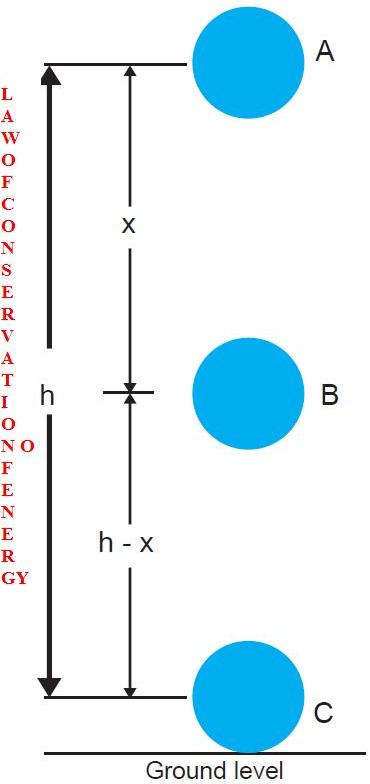
Let a body of mass m falls from a point A, which is at a height h from the ground as shown in fig.

At A,

Kinetic energy kE = 0
Potential energy Ep = mgh
Total energy E = Ep + Ek = mgh + 0= mgh
During the fall, the body is at a position B. The body has moved a distance x from A.
At B,
velocity v2 = u2 + 2as
applying, v2 = 0 + 2ax = 2ax
Kinetic energy Ek = 1/2 mv2 = 1/2 m x 2gx = mgx
Potential energy Ep = mg (h – x)
Total energy E = Ep + Ek = mg (h-x) + mgx = mgh – mgx + mgx= mgh

If the body reaches the position C.

At C,

Potential energy Ep = 0
Velocity of the body C is
v2 = u2 + 2as
u = 0, a = g, s = h
applying v2 = 0 + 2gh = 2gh

kinetic energy Ek =1/2 mv2=1/2 m x 2gh= mgh

Total energy at C
                      E = Ep + Ek
                     E = 0 + mgh
                     E = mgh
Thus we have seen that sum of potential and kinetic energy of freely falling body at all points remains same. Under the force of gravity, the mechanical energy of a body remains constant.

RATE OF DOING WORK (OR) POWER
Power is defined as the rate of doing work or work done per unit time.
Power  =work done/time taken
        P = w/t
UNIT OF POWER
The unit of power is J/S known as watt, its symbol is W.
1 watt =1 joule/1 second
1 W = 1 J/ S

1hp=746W

Commercial unit of energy is kilo watt hour

We pay electricity bill in terms of unit or kWh. It is a commercial unit of electric energy consumed by the user.

Watt hour = power in watt x time in hour.

Example : How much energy will be used when a hundred watt bulb is used for 10 hour?

Energy = 100 watt x 10 hour = 1000 w h = 1kw h

I kwh is known as 1 unit.

One kilowatt hour means thousand watt of power is consumed in one hour.

1 kWh  = 1 kW x 1 h
            = 1000 W x 60 x 60 s
            = 1000 Js-1 x 3600 s
            = 3.6 x 10⁶ J
1 unit = 1 kilowatt hour = 3.6x10 J


Solved CBSE Test papers:

Class 9 Work, Energy ,Power_ Solved Questions - 01

Class 9 Work, Energy ,Power_ Solved Questions - 02

Class 9 Work, Energy ,Power_ Solved Questions - 03

Class 9 Work, Energy ,Power_ Solved Questions - 04

Class 9 Work, Energy ,Power_ Solved Questions - 05

Class 9 Work, Energy ,Power_ Solved Questions - 06          Download Files

08 October 2011

CBSE TEST PAPER SCIENCE & TECHNOLOGY (Class-9)Work and Energy

CBSE PHYSICS 9th Work and Energy

One marks question

1. Define kinetic energy.

2. What is potential energy

3. What will be the work done by a force if displacement of the body is zero?

4. When is work done on a body positive?

5. Can energy be converted from one form to another?

2 marks questions

1. A constant force of 10N displaces a body through 5 m. Find the work done by the force?

2. What will be the work done if a stone of mass 2 kg is raised through a height of 10cm?

3. What are the conditions needed for work to be done?

4. An object of mass 10kg is moving with speed 4 m/sec. What is the kinetic energy of the object

5. An electric bulb of 60w is used for 5 hours a day. Calculate the energy consumed in one day by 
the  tube?

3 marks questions

1. An object of mass 10kg is at a certain height above the ground. If the potential energy of the 
object  is 200 j find the height of the object from the ground?

2. A body of mass 5 kg is kept on a table. If it is displaced by a force of 10 N by 2 m on the table on 
the same horizontal line, find the work done by the gravitational force

3. A ball of mass 2 kg is kept on a tower of height 30 m. Find its potential energy at this point. If it is  allowed to fall freely, find its kinetic energy when it just touches the ground

4. What is law of conservation of energy prove it ?

5. A man of mass 50 kg climbs a tower of height 45 m in 5 seconds with the help of a rope. Find the  power of the man?

5 marks questions

1. If in an office, 10 tubes of 40 W, 5 fans of 75 W and 2 ACs of 1500W are used for 8 hours a day. 

Calculate the energy consumed per day in commercial units of energy.)

2. Prove that the kinetic energy of a body moving with speed v is equal to ½ mv2


Solved CBSE Test papers:
Class 9 Work, Energy ,Power_ Solved Questions - 01

Class 9 Work, Energy ,Power_ Solved Questions - 02

Class 9 Work, Energy ,Power_ Solved Questions - 03

Class 9 Work, Energy ,Power_ Solved Questions - 04

Class 9 Work, Energy ,Power_ Solved Questions - 05

Class 9 Work, Energy ,Power_ Solved Questions - 06 Download Files

06 October 2011

Class IX Work Power and Energy notes(Physics)

Work: In our daily life anything that makes us tired is known as work. For example, reading, writing, painting, walking, etc.

In physics work (W) is said to be done, when a force (F) acts on the body and point  of application of the force is displaced (s) in the direction of force.

Work done = force x displacement

    W          =     F       x       s

(i) If the body is displaced in the same direction of force, Work done is positive
(ii) If the displacement is against a force, the work is done against the force. Work done is negative
(iii) If the displacement is perpendicular to the direction of the force, work done is zero.

Unit of work

Unit of work is joule (J). One joule of work is said to be done when a force of 1 Newton acting on a body displacing it by a distance of 1 m.

Larger units of work are

i) kilo joules      (1000 joule)         

 ii) mega joule  (10 lakh  joule)

ENERGY -   The energy of the body is defined as its capacity to do work

Unit of energy - Energy is measured in terms of work. Unit of energy is also joule. One joule of energy is required to do one joule of work

Different forms of energy

1. Mechanical Energy

The energy used to displace a body or  to change the position of the body or to deform the body is known as mechanical energy.

Mechanical energy is of two types   (i) Potential energy    (ii) Kinetic energy.

POTENTIAL ENERGY

The energy possessed by a body by virtue of its position or due to state of strain, is called potential energy.

Example :The work done to lift a body above the ground level gives the potential energy of the body. Eg. Weight lifting.

Water stored in reservoir  has large amount of potential energy due to which it can drive a water turbine when allowed to fall down. This is the principle of production of hydro electric energy.

Expression for potential energy of a body above the ground level


Consider an object of mass m. It is raised through a height “h” meter  from the ground.


By applying force F, The object gains energy to do the work done (w) on it.
Work done = force x displacement
              w = F x h       (Since F= m a , a = g , F = mg)
 w = m g h

KINETIC ENERGY-    Energy possessed by an object due to its motion is called kinetic energy.

Kinetic energy of an object increases with its speed. Kinetic energy of an object moving with a velocity is equal to the  work done on it to make it acquire that velocity

Example -   Kinetic energy of a hammer is used to drive a nail into the wall.  Bullet fi red from a gun can penetrate into a target due to its kinetic energy.


Expression for kinetic energy:

Let a body (ball) of mass m is moving with an initial velocity v. If it is brought to rest by applying a retarding (opposing) force F, then it comes to rest by a displacement S.

Let,  Ek = work done against the force used to stop it.
Ek = F x S ---- (i)
But retarding force F = ma-----(ii)
Let initial velocity u = v, final velocity v = 0
From III equation of motion
v2 = u2 + 2aS

Applying, 0 = v2 – 2aS (  a is retardation)
2aS = v2
Displacement, S = v2/2a          ---- (iii)

Substituting (ii) and (iii) in (i)
Ek = ma x v2/2a   
Ek = 1/2 mv2

LAW OF CONSERVATION OF ENERGY

Energy can neither be created nor destroyed, but it is transformed from one form to another. Alternatively, whenever energy gets transformed, the total energy remains unchanged.

Proof – Freely falling body

Consider a body of mass m falls from a point A, which is at a height h from the ground as shown in fig.

At A,

Kinetic energy Ek = 0
Potential energy Ep = mgh
Total energy E = Ep + Ek
                        = mgh + 0
                    E  =  mgh
During the fall, the body is at a position B. The body has moved a distance x from A.

At B,

Velocity v2 = u2 + 2as         
Applying, v2 = 0 + 2ax = 2ax
Ek = 1/2 mv2
                  =1/2 m x 2gx
                  = mgx
Potential energy
E p = mg (h – x)
Total energy E = Ep + Ek
                        = mg (h-x) + mgx
= mgh – mgx + mgx
E = mgh
If the body reaches the position C.

At C,       

Potential energy E p = 0   
Velocity of the body C is      v2 = u2 + 2as
 u = 0, a = g, s = h
Applying v2 = 0 + 2gh = 2gh
Kinetic energy Ek = 1/2 mv2   = 1/2x m x 2gh     Ek = mgh
Total energy at C
                       E = E p + E k
                       E = 0 + m g h
                       E = m g h
Thus sum of potential and kinetic energy of freely falling body at all points remains same.

Power :  Power is defined as the rate of doing work or work done per unit time

Power      =          work done/time taken
         P     =            w / t
UNIT OF POWER
The unit of power is J/S known as watt, its symbol is W.
1 watt = 1 joule/1 second
1 W = 1 J S -1
1 kilowatt = 1000 watts
1 kW = 1000 W
1 kW = 1000 J /s.
Commercial unit of energy is kilo watt hour

Average power

Work done done by a peson or  agent may be diffrent at different intervals of time. Therefore the concept of average power is useful. 

We obtain average power by dividing  the total energy consumed by the total time taken.

Example 1.  How much energy will be used when a hundred watt bulb is used for 10 hour?
Energy = 100 watt x 10 hour
           = 1000 w h = 1kw h
I k w h is known as 1 unit.
One kilowatt hour means thousand  watt of power is consumed in one hour.
1 kWh = 1 kW x 1 h
          = 1000 W x 60 x 60 s  
         = 1000 Js-1 x 3600 s
        = 3.6 x 10⁶ J
1 unit = 1 kilowatt hour = 3.6x10⁶ J

Example 1: An electric bulb of 60 W is  used for 6 h per day. Calculate the ‘units’ of energy consumed in one day  by the bulb.

Solution:       Power of electric bulb = 60 W  = 0.06 kW.  Time used, t = 6 h
Energy = power × time taken   = 0.06 kW × 6 h   = 0.36 kW h   = 0.36 ‘units’.
The energy consumed by the bulb is 0.36 ‘units’.

Solved CBSE Test paper:

Class 9 Work, Energy ,Power_ Solved Questions - 01

Class 9 Work, Energy ,Power_ Solved Questions - 02

Class 9 Work, Energy ,Power_ Solved Questions - 03

Class 9 Work, Energy ,Power_ Solved Questions - 04


Class 9 Work, Energy ,Power_ Solved Questions - 05

Class 9 Work, Energy ,Power_ Solved Questions - 06        Download Files

Add and comment