Showing posts with label 10th The Humane Eyes and Dispersion of light. Show all posts

15 December 2011

X Human Eye and the Colourful World (MCQ)Multiple choice questions


Multiple choice questions
1. When we enter a cinema hall, we cannot see properly for a short time. This is because-
a) Pupil does not open                                                 b) Pupil does not close
c) Adjustment of size of pupil takes some time            d) None of these above                                Ans: (c)
2. The property of persistence of vision is used in-
a) Short sightedness b) Long sightedness c) Cinematography d) Colour vision                               Ans: (c)
3. Variable focal length of eye is responsible for-
a) Accommodation of eye b) Persistence of vision
c) Colour blindness d) Least distance of distinct vision                                                                    Ans: (a)
4. A concave lens of suitable focal length is used for correcting a-
a) Myopic eye b) Hypermetropic eye c) Both a and b d) nor a nor b                                                Ans: (a)
5. Splitting of white light into seven colours on passing through the glass prism is called-
a) Reflection b) Refraction c) Scattering d) Dispersion                                                                     Ans: (d)
6. The broad wavelength range of visible spectrum is-
a) 4000-8000A                b) 2000-4000A               
c) 10000-20000A    d) None of the above            Ans: (a)
7. For which colour, refractive index of glass is maximum?
a) Red b) Violet c) Green d) Yellow                                                                                                    
Ans: (b)
8. Which colour suffers least deviation on passing through a prism?
a) Red b) Violet c) Indigo d) Blue                                                                                                      
Ans: (a)
9. Blue colour of sky is due to-
a) Scattering of light b) Reflection of light c) Refraction of light d) Diffraction of light                      
 Ans: (a)
10. Clouds appear red due to Rayleigh scattering. The statement is-  a) True b) False                  
Ans: (b)
11. Red colour of the sun at the time of sunrise and sunset is because-
a) Red colour is least scattered                                  b) Blue colour is least scattered
 c) Red colour is scattered the most                         d) All colours are equally scattered                   
Ans: (a)
12. A human eye can focus objects at different distances by adjusting the focal length of the eye lens. This is due to –  (a)Persistence of vision   (b)Near sightedness (c)Accommodation  (d)Far sightedness        Ans: (c)
13. Cinematography makes use of -         (a) Accommodation                 (b) Persistence of vision  
(c) Least distance of distinct vision (d) Bi-focal lens system                                                                   Ans: (b)
14. Human eye forms the image of an object at its –
(a)Cornea  Pupil  Iris  Retina                                                                                                          
Ans: (d)
15. The change of focal length of an eye lens to focus the image of objects at varying distances is done by the action of the -  (a)Pupil  (b)Retina  (c)Ciliary muscles  (d)Blind spot                                               Ans: (c)
16. The convex lens of focal length 20cm each are separated by a distance of 10cm for focal length of combination is :-  (a) 20cm  (b) 40cm (c) 30cm (d) 13.3cm                                                                       Ans: (d)
17. Two convex lenses of focal length 10cm and 20cm are kept in contact .The focal length of the combination is:          (a) 20/3 cm  (b) 40 cm            (c) 12cm      (d) 15 cm                                                                Ans: (a)
18. Two lenses of power –1.75D and +2.75D are placed in contact. The focal length of the combination is :-
(a)50cm         (b)100cm          (c)  75cm       (d)       125cm                                                                     Ans: (b)
19. Which eye piece satisfies the condition for spherical aberration:-
(a)Huygen’s eye piece         (b)Ramsden’s eye piece        (c)Both a and b  (d)None of the above     
 Ans: (a)
20. A myopic person cannot see clearly:-
(a)Distant objects   (b)Near objects  (c)Near and distant objects  (d)None of the above                     
Ans: (b)
21. A long-sighted person cannot see clearly:
(a)Near objects               (b) Distant objects        (c) Both distant and near objects      (d) None         
Ans: (a)
22. A person having Presbyopia should use:-
(a)Convex lens             (b) Concave lens   (c) Cylindrical lenses               (d) Bifocal lenses                 Ans: (d)
23. A person cannot see fundamental colours (red, blue, green). This defect is called:-
(a) Myopia          (b) Presbyopia            (c) Colour blindness         (d) Astigmatic                                  Ans: (c)
24. The defect of astigmatism can be rectified by using: -
(a)Convex lens          (b)  Cylindrical lens       (c) Concave lens         (d )  Bifocal lens                          Ans: (b) 

10 December 2011

Interesting Atmospheric Refraction Phenomena


1. A student sitting at the back of the classroom cannot read clearly the letters written on the blackboard. What advice will a doctor give to her?

Ans: The student is suffering from myopia (near sightedness). Doctor advises her to use a concave lens of appropriate power to correct this defect.

2. How are we able to see nearby and also the distant objects clearly?
Ans: Human eye is able to see nearby and distant objects clearly by changing the focal length of the eye lens using its power of accommodation.

3. A person needs a lens of power –4.5 D for correction of her vision.

(a) What kind of defect in vision is she suffering from?

(b) What is the focal length of the corrective lens?

(c) What is the nature of the corrective lens?


Ans: (a) Negative sign of power of lens indicates that focal length is negative that is only possible in concave lens that is used for correction of Myopia

(b) f =1/-4.5 =-2/9= – 0.22 m,

(c) The nature of the corrective lens is diverging rays of light.

4. Is the position of a star as seen by us its true position? Justify your answer.

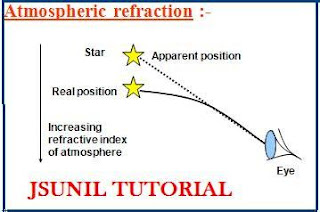
No. light from stars undergoes atmospheric refraction which occurs due to the variation in air density.

5. Why do we see a rainbow in the sky only after rainfall?

We see a rainbow in the sky only after rainfall because the water droplets behave like prisms and disperse sunlight. due to atmospheric refraction and total internal refraction. A rainbow is always formed in a direction opposite to that of the sun. The water droplets act like small prisms. They refract and disperse the incident sunlight, then refract it internally and finally refract it again when it comes out of the raindrop.

6. Why is the colour of the clear sky blue?
Ans: Blue coloour gets scattered the maximum due to less wave velocity.

7. What is the difference in colours of the Sun observed during sunrise/sunset and noon? Give explanation for each.

Ans: During sunrise and sunset the sun appears reddish whereas at noon the sun appears white.
At sunrise and sunset the light coming from the sun has to travel a longer distance through the atmosphere to reach us. Ttherefore the blue and green components of white light are gets scattered away (removed) almost completely leaving the longer wavelength. Hence, during sunrise and sunset the sun appears reddish.

When the sun is overhead at noon, then the light coming from the sun has to travel a relatively shorter distance through the atmosphere to reach us. As a result, only a little of the blue colour of the white light is scattered (most of the blue light remains in it). Since the light coming from the overhead sun has almost all its components colours in the right proportion, therefore, the sun appears white

8. Chicken can see only in bright light. What type of cells is present in its retina?

Ans: Its retina has only rod cells and no cone cells.

9. Give reason: What will be colour of the sky in the absence of atmosphere?

Ans: In the absence of any atmosphere, there will be no scattering of sunlight and the sky will appear dark.

10. Give reason: Why are the traffic light signals (or danger signals) of red colour?

Ans: In the visible spectrum, the red colour has the largest wavelength. The red colour is least scattered by fog or dust particles. Therefore, we can observe red colour easily even in foggy and dusty conditions.

11. Why does the sky appear dark and black to an astronaut instead of blue?

Ans: This is because there is no atmosphere containing air in the outer space to scatter light. Since there is no scattered light, which can reach our eyes in outer space, therefore, the sky looks dark and black there. This is why the astronauts who go to outer space find the sky to be dark and black instead of blue.

12. What is Tyndal Effect? Explain with an example.

Ans. The scattering of light by particles in its path is called Tyndall Effect.

When a beam of sunlight enters a dusty room through a window then its path becomes visible to us. This is because the tiny dust particles present in the air of room scatter the beam of light all around the room. And when thus scattered light enters our eyes, we can see the beam of light. Thus, an example of Tyndall effect is the way a beam of sunlight becomes visible as it passes through dust particles in the air of a room.

13. The sun near the horizon appears flattened at the sun set and sun rise. Explain why.

Ans: - This is due to atmospheric refraction. The density and refractive index of the atmosphere decreases with altitude, so the rays from the top and bottom portion of the sun on horizon are refracted by different degrees. This causes the apparent flattening of the sun. But the rays from the sides of the sun on a horizontal plane are generally refracted by the same amount, so the sun still appears circular along the sides.
14.Why We can see the sun about 2 minutes before the actual sunrise, and about 2 minutes after the actual sunset 

Ans: We can see the sun about 2 minutes before the actual sunrise, and about 2 minutes after the actual sunset because of atmospheric refraction. By actual sunrise, we mean the actual crossing of the horizon by the Sun.  

When the sun just below the horizon its rays enters earths atmosphere and refracted towards the earth. Refracted ray that reach us making it appears the sun reaches to horizon. This is the apparent sunrise. But actual sunrise occur when sun reach to horizon. Conversely apparent sunset occur slightly latter than actual sun set . Since light from sun already below the horizon it refract through atmosphere enabling us to see apparent sun set even sun has already set.

15.What is night blindness? How is it caused and can it be corrected ?

Ans. Some persons have difficulty in seeing the objects in dim light during night. This defect of eye is called night-blindness. 
 Causes are :
(1) Lack of vitamin A in the food. 
 (2) Improper functioning of rod-shaped cells.
It is corrected by using contact lenses. Soft contact lenses allow more of oxygen to reach than hard lenses. They bend the rays of light to correct their refractive angle, which enables a sharp image to be formed at the retina.

26 November 2011

8th physics light reflection refraction eyes defect and dispersion

The ray of light which falls on the mirror surface is called incident ray.

The point at which the incident ray strikes the mirror is called the point of incidence.
The ray of light which is sent back by the mirror is called the reflected ray.

The ‘normal’ is a line drawn at right angles to the mirror surface at the point of incidence.
The angle between incident ray and normal is called the angle of incidence.

The angle between reflected ray and normal is called the angle of reflection.


Laws of reflection of light:

Ø The incident ray, the reflected ray, and the normal {at the point of incidence}, all lie in the same plane.

Ø The angle of reflection is always equal to the angle of incidence.


Regular Reflection and Diffuse Reflection of Light


Regular Reflection


In regular reflection, a parallel beam of incident light is reflected as a parallel beam in one direction.


Regular reflection of light occurs from smooth surfaces like that of a plain mirror.


Images are formed by regular reflection of light.


Diffused Reflection


In Diffuse reflection, a parallel beam of incident light is reflected in different directions.


The diffuse reflection of light takes place from rough surfaces


A sheet of paper produces diffuse reflection of light.


No image is formed in diffuse reflection of light.


Characteristics of image formed by a plane mirror


Ø The image formed by a plane mirror is virtual & Erect.


Ø The image formed in a plane mirror is the same distance behind the mirror as the object is in front of it.


Ø The image formed in a plane mirror is of the same size as the object.


Ø The image in a plane mirror is laterally inverted.


Periscope : A Periscope is a device through which a person can se the objects that are out of the direct line of sight.


For example, by using a periscope, we can see the objects on the other side of a high wall which cannot be seen by us directly. Periscope has two plane mirrors arranged parallel to one another.


Each plane mirror, however, makes an angle of 450 with the side of the tube.


Some of the uses of periscopes are given below:


Ø Periscope is used to see over the heads of a crowd


Ø A Periscope is used by soldiers sitting in bunker to observe the enemy activities outside {over the ground}.


A Periscope is used by a navy officer sitting in a submarine to see ships over the surface of water in the sea.


Multiple Images: When two plane mirrors are kept inclined at an angle, they can form multiple images of an object. If two plane mirrors are inclined at an angle q, then the number of images formed in them is given by the formula:


No. of images formed = (3600/ q) - 1


Kaleidoscope : The kaleidoscope is an instrument which produce multiple reflections of coloured glass pieces {or coloured plastic pieces} and create beautiful patterns.


Construction: The Kaleidoscope consists of three long and narrow strips of plane mirrors inclined at 600 to one another forming a hollow prism, and fitted into a cardboard tube.


One end of the cardboard tube is closed by an opaque disc {cardboard disc} having a small hole at its centre. The other end of cardboard tube is closed with circular discs of glass. The inner disc being of transparent glass {clear glass } and the outer disc of ground glass {translucent glass}.


A number of small pieces of different coloured glass {or plastic } and having different shapes are kept between the two glass discs {which can move around freely in the space between the two glass discs}. When we hold the kaleidoscope tube towards light and look inside it through the small hole, we see beautiful patterns of coloured glass.


Patterns formed by Kaleidoscope


Dispersion of light


The splitting up of white light into seven colours on passing through a transparent medium like a glass prism is called dispersion of light. The seven colours of the spectrum of white light are: violet, indigo, blue, green, yellow, orange and Red.


The Human Eye


The main parts of the human eye are : Cornea, Iris, Pupil, Ciliary muscles, Eye lens {which is a flexible convex lens}, Retina and Optic nerve.
Cornea is made of a transparent substance
The light coming from an object enters into the eye hrough cornea. Functionof cornea is to protect the eye.
Iris is the colored part of the eye. The iris has a hole at its centre which is called pupil. Pupil appears like a dark spot in the centre of iris because no light is reflected from it. Iris controls the amount of light entering the eye by adjusting the size of pupil.
The eye-lens is a convex lens made of a transparent and flexible material.
The eye-lens is held in position by ciliary muscles. The function of ciliary muscle is to hold the lens & changes its size according to the need.
The retina is a screen on which the image is formed in the eye.
The optic nerve carries the image formed on retina to the brain in the form of electrical signals. Rods and cones


Rods are the rod-shaped cells present in the retina of an eye which are sensitive to dim light.
Cones are the cone-shaped cells present in the retina of an eye which are sensitive to bright light. Cones also cause the sensation of colour of objects in our eyes.
Blind spot
At the junction of optic nerve and retina in the eye, there are no light sensitive cells {no rods or cones }due to which no vision is possible at spot. This is called blind spot.
Persistence of vision
The image of an object seen by our eyes persists {or remains}on the retina for about 1/16th of a second even after the object has disappeared from our view. The abilily of an eye to continue to see the image of an object for a very shot duration even after the object has disappeared from view, is called persistence of vision.
Defects of the Eye:
a) Myopia (short-sightedness) : In this defect the person is able to see the near by objects but not able to see the far-off objects.
This defect can be corrected by using spectacles containing Concave lens.
b) Hypermetropia (Far-sightedness) : In this defect the person is able to see the far-off objects but not able to see the near by objects.
This defect can be corrected by using spectacles containing Convex lens.c) Cataract : Cataract develops when the eye lens of person becomes cloudy (or even opaque) due to the formation of membrane over it. Cataract decreases the vision of the eye gradually. It can even lead to total loss of vision of the eye.
The opaque lens is removed from the eye of the person by surgical operation & a new artificial lens is inserted in its place.
Refraction of Light
The deviation in the path of light when it passes from one medium to another medium of different density is called refraction.
The twinkling of stars is due to atmospheric refraction of starlight. Since the atmosphere bends starlight towards the normal the apparent position of the star is slightly different from its actual position. Hence the star appears slightly higher than its actual position.
Refraction and Reflection of Light
IO incident ray OR' reflected ray OR refracted ray
The diagram shows how the light gets refracted when it is traveling from one optical medium to another. Like reflection, refraction of light takes place according to certain laws.
Terms which are commonly used to explain the phenomenon of refraction.
Incident Ray The ray of light striking the surface of separation of the mediums through which it is traveling is known as the incident ray.
Point of Incidence The point at which the incident ray strikes the surface of separation of the two mediums is called the point of incidence.
Normal The perpendicular drawn to the surface of separation at the point of incidence is called the normal.
Refracted Ray The ray of light which travels into the second medium, when the incident ray strikes the surface of separation between the mediums 1 and 2, is called the refracted ray.
Angle of Incidence (i) The angle which the incident ray makes with the normal at the point of incidence, is called angle of incidence.
Angle of Refraction (r) The angle which the refracted ray makes with the normal at the point of incidence, is called angle of refraction.
Cause of Refraction A ray of light refracts or deviates from its original path as it passes from one optical medium to another because the speed of light changes.
Laws of Refraction

The incident ray, the refracted ray and the normal to the surface at the point of incidence all lie in one plane.
For any two given pair of mediums, the ratio of the sine of the angle of incidence to the sine of the angle of refraction is a constant. The above law is called Snell's law after the scientist Willebrod Snellius who first formulated it Thus, Sin i /Sin r = a constant = m
Where m is the refractive index of the second medium with respect to the first medium.
We know that the phenomenon of refraction is taking place because the speed of light changes when it is traveling from one optical medium to another. Thus we can define refractive index in terms of the speed of light in the two media. The refractive index of glass with respect to air is given by the relation
m = speed of light in air/speed of light in glass

If the medium 1 is air or vacuum, the refractive index of medium 2 is referred to as the absolute refractive index. Critical angle is that angle of incidence for which a ray of light while moving from a denser to a rarer medium just grazes over the surface of separation of the two media (that is, angle of refraction = 90o).
Total Internal Reflection
If the angle of incidence of a ray of light traveling from a denser medium to a rarer medium is greater than the critical angle for the two media, then the ray is reflected into the denser medium and this phenomenon is described as total internal reflection.
The conditions to be satisfied for total internal reflection to take place are

The ray of light must travel from a denser medium to a rarer medium.

The angle of incidence must be greater than the critical angle for those two mediums. The refractive index of a medium depends on the following factors:
1. the nature of the medium 2. the color or wave length of the incident lightPoints to remember
1.) There can be only one reflected ray for a given single incident ray falling on a plane mirror.
2.) A ray of light which is incident normally on a mirror is reflected back along the same path because the angle of incidence for such a ray of light is 0o the angle of reflection is also 00.
3.) Diffuse reflection is caused by the roughness in the reflecting surface of an object.
4.) Laws of reflection are valid for both regular reflection & irregular reflection.
5.) If a person is standing at a distance of 1 metre in front of a plane mirror, then distance between the person & his image will be 2 metres.
6.) In an image formed by plane mirror, the left side of the object appears on the right side in the image whereas the right side of the object appears on the left side in the image.
This change of sides of an object & its mirror image is called Lateral inversion.
7.) As the angle between the two plane mirrors decreases, the number of images formed increases.
When the angle between the two plane mirrors becomes 0 deg ie. When the two mirrors are parallel to each other then infinite number of images is formed.
8.) An interesting feature of a kaleidoscope is that we can never see the same patterns again. Every time a new pattern is formed. Kaleidoscope are used by designers of wall papers & fabrics, as well as by artists to get ideas for new patterns.
9.) Rainbow in the sky is natural phenomenon showing the dispersion of sunlight. Rainbow is produced by the dispersion of sunlight by the tiny rain drops suspended in the atmosphere (which act as tiny prisms made of water).
10.) The adjustment of the size of pupil takes some time. That’ when we go from a bright light to a darkened cinema hall, at firstwe cannot see our surroundings clearly.
11.) The range of vision of a normal human eye is from infinity to about 25 centimeters.
03 October 2011

CBSE Question Bank Class 10 Physics The Humane Eyes and Dispersion of light

Very short answer Questions (1 mark)
1. Is the eye lens convex or concave?
2. What is the far point of a normal eye?
3. What is the near point of a normal eye?
4. How is the amount of light entering the eye controlled?
5. Which defect of vision can be rectified by convex lens?
6. Which defect of vision can be rectified by concave lens?
7. Define power of accommodation of eye.
8. Which colour suffers maximum deviation on passing through a prism?
9. Give two examples for atmospheric refraction.
10. Give the essential condition for observing a rainbow.
Short answer questions (2 marks)

Add and comment